The Protocol: Fresh Ethereum Scaling Plans
What to Know
- Vitalik Buterin published a blog post outlining near-term and long-term strategies for scaling Ethereum's base layer
- OKX launched an AI-focused upgrade to its OnchainOS developer platform, enabling autonomous crypto trading agents across chains
- NEAR co-founder Illia Polosukhin predicts AI agents will become blockchain's primary users, replacing human-facing interfaces
- Bitcoin's BIP-110 governance clash escalated as mining pool Ocean produced the first block signaling support for the soft fork proposal
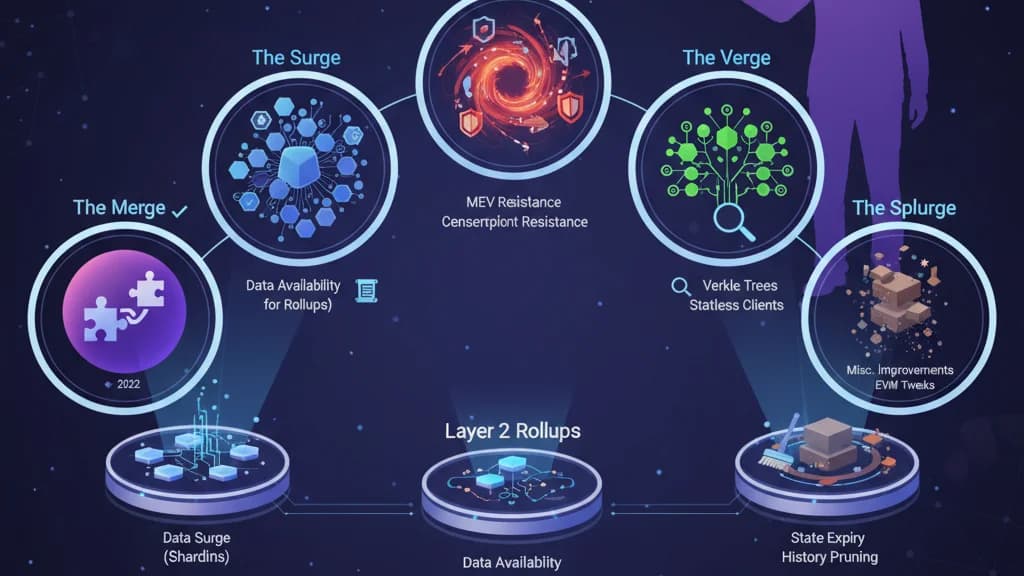
Ethereum scaling dominated this week's protocol developments as co-founder Vitalik Buterin laid out an ambitious new vision for boosting the blockchain's capacity. Buterin's blog post, published on X on March 4, argues the network can increase throughput in the near term while preparing for a longer-term transition to advanced cryptography and data-heavy blobs. The proposal marks a notable pivot back toward base-layer improvements after several years in which the ecosystem's scaling strategy relied heavily on layer-2 rollups. This week's roundup also covers OKX building AI agent infrastructure, NEAR's co-founder predicting AI will become blockchain's dominant user base, and Bitcoin's escalating governance fight over BIP-110.
What Is Buterin's New Ethereum Scaling Vision?
The central thrust of Vitalik Buterin's proposal is that Ethereum can safely scale in the near term by making blocks easier and faster to verify, letting the network handle significantly more transactions per cycle. Upcoming protocol upgrades will allow the computers running Ethereum to review different portions of a block simultaneously, rather than processing every element step by step as the network does today.
In parallel, modifications to block construction through a mechanism known as ePBS will allow the network to utilize a larger portion of each 12-second processing window. Currently, blocks finish early as a precaution. The ePBS implementation, scheduled for the Glamsterdam upgrade, would remove that conservative buffer and enable blocks to carry substantially denser transaction loads.
The plan arrives on the heels of the Ethereum Foundation publishing a 'strawmap' aimed at making the network more efficient over the long haul. Buterin's post reflects a renewed emphasis on Ethereum scaling at the protocol level, signaling a shift from relying exclusively on rollup-based solutions. Together, these proposals chart a two-track approach: immediate capacity gains through validator optimizations alongside a longer-term migration to advanced cryptographic techniques and heavier blob usage.
Rethinking How Gas Fees Are Calculated
Another critical element of Buterin's roadmap involves overhauling how transaction fees, commonly known as gas, are calculated on Ethereum. He argues that the current pricing model fails to distinguish between different types of strain on the network. Using computing power temporarily, for instance, imposes a fundamentally different cost than permanently writing new data that every Ethereum node must store indefinitely.
By differentiating between these resource demands, Ethereum could price transactions more accurately and discourage unnecessary permanent data storage that burdens node operators. The gas reform would complement the throughput improvements, ensuring the network charges proportionally for the actual load each transaction places on infrastructure. Buterin contends that granular pricing is essential as the blockchain scales, preventing low-value permanent data from crowding out higher-priority financial transactions.
OKX Rolls Out AI Agent Infrastructure
Beyond Ethereum, OKX rolled out an AI-focused upgrade to OnchainOS, its developer platform, positioning the toolkit as infrastructure for autonomous crypto trading agents. The AI layer builds on familiar components such as wallet infrastructure, liquidity routing, and on-chain data feeds, combining them into a unified execution framework for agents operating across multiple blockchains.
Rather than manually wiring price feeds, token approvals, gas estimation, and swap routing, developers can connect an agent and issue a high-level instruction, such as swapping ETH for USDC below a specified price threshold. OnchainOS then handles the complete workflow from monitoring markets and sourcing liquidity to confirming settlement on-chain.
The intersection between crypto and artificial intelligence has grown exponentially over the past 12 months. The blockchain AI market is projected to rise from $6 billion in 2024 to $50 billion by 2030, according to industry estimates. In one recent example, a group of retail traders used AI to identify pricing inefficiencies on platforms like Polymarket before instructing automated agents to execute trades on their behalf.
How Will AI Agents Reshape Blockchain Usage?
AI agents will become the primary users of blockchain networks rather than humans, according to NEAR co-founder Illia Polosukhin. In an interview, Polosukhin argued that artificial intelligence will serve as the front-end interface for everything online, including cryptocurrency, while blockchain recedes into back-end infrastructure that end users never directly see.
"The users of blockchain will be AI agents," Polosukhin said. "AI is going to be on the front end, and blockchain is going to be the back end." His framing cuts against much of crypto's recent experimentation with AI, which has centered on speculative tokens, memecoins, and agent-themed trading bots rather than genuine infrastructure integration.
"The goal is to make your AI hide all the blockchain," Polosukhin added. "The fact that we have explorers is effectively a failure, because we don't abstract the technology." Under his model, AI agents would interact directly with protocols to execute payments, manage digital assets, coordinate services, and even vote in governance systems. Humans would engage only with the AI layer above.
Bitcoin Governance Clash Over BIP-110
Bitcoin's latest governance clash escalated this week as mining pool Ocean produced the first block signaling support for a temporary soft fork designed to restrict arbitrary, non-monetary data in the blockchain's transactions. The proposal, formally designated BIP-110 after evolving through earlier drafts, seeks to reinstate strict limits on transaction output sizes and arbitrary data fields for approximately one year.
Proponents argue that unchecked non-financial data, including large inscriptions and so-called OP_RETURN payloads, threaten Bitcoin's original purpose as sound monetary infrastructure and impose unnecessary storage burdens on node operators. The soft fork would curb what supporters characterize as spam uses of block space.
The community remains deeply divided. Blockstream CEO Adam Back warned that consensus-level intervention could harm Bitcoin's credibility and lead to preferential treatment of certain transactions, violating the principle of neutral transaction capacity. Back also questioned the level of support for the proposal, cautioning that pushing forward without sufficient consensus increased the risk of a chain split.
Stay ahead of the market.
Crypto news and analysis delivered every morning. Free.
More from Bitcoinomist
About the Author
Senior Crypto Journalist
Kevin Giorgin is a senior crypto journalist with over five years of experience covering Bitcoin, DeFi, and blockchain technology at Bitcoinomist.
View all contributors
Follow bitcoinomist.io on Google News to receive the latest news about blockchain, crypto, and web3.
Follow us on Google News